
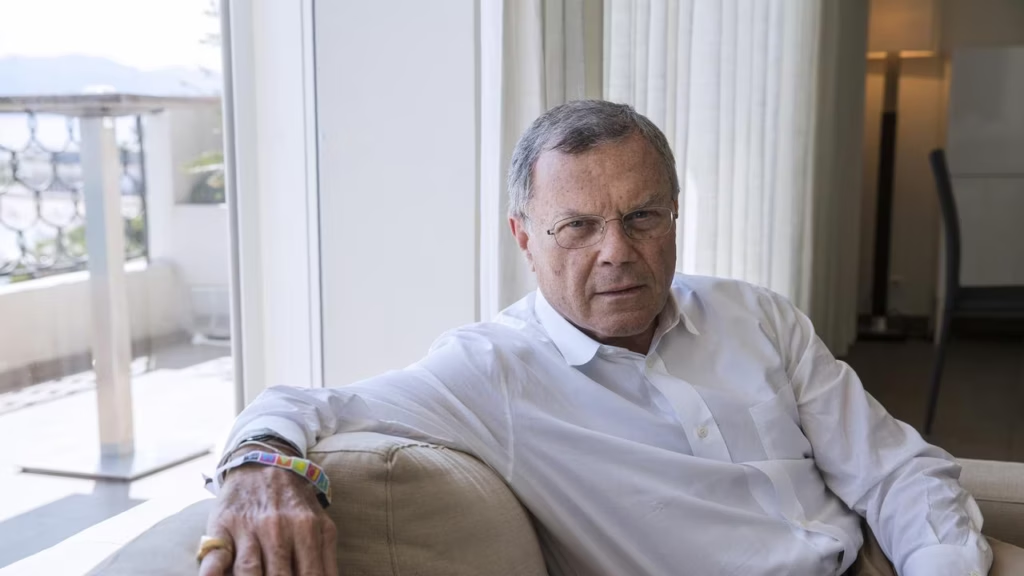
As the founder of WPP—which he scaled over three decades into the world’s largest advertising and marketing services behemoth—and subsequently founder and executive chairman of S4 Capital, Sir Martin Sorrell has spent half a century at the epicenter of global media, corporate strategy, and brand evolution. In this candid conversation with Muhammad Aljunied, he reflects on the tectonic shifts reshaping commerce, the collision of data and creativity, and the psychological realities driving modern luxury and consumer markets.
Muhammad Aljunied: Sir Martin, looking back across your extraordinary career—having built WPP into a global titan over thirty-three years and now disrupting the digital-first landscape with S4 Capital—how has the fundamental DNA of global media and branding shifted from the traditional agency era to today’s hyper-fragmented digital ecosystem?
Sir Martin Sorrell: The shift is tectonic. If you look at the old model of the twentieth century, it was built on analogue monopolies—linear television, print, and radio—where clients paid massive retainers for traditional campaigns, and the agencies operated like slow, comfortable holding companies.
Today, that entire edifice has been upended by technology, platforms, and data. Consumers don’t consume media passively anymore; they interact, transact, and demand hyper-personalized relevance in real-time. What hasn’t changed, however, is the core objective: building brand equity and driving sales. At S4 Capital, our entire thesis was built on recognizing this transition early—focusing on a purely digital, first-party data-driven model that merges content, data, and technology at lightning speed. If you aren’t agile, data-literate, and fully integrated in the digital space, you are already obsolete.
Muhammad Aljunied: We often hear a false dichotomy in the market: that data and analytics have somehow killed pure creative magic. Having overseen campaigns for virtually every major global brand on earth, how do you view the intersection of rigorous data science and emotional creativity?
Sir Martin Sorrell: That dichotomy is complete nonsense. Data without creativity is sterile and boring; creativity without data is just expensive guesswork.
Data gives you the roadmap—it tells you who the audience is, where they are, what friction points exist, and how they behave. But creativity is the fuel that captures their imagination and drives an emotional connection. The best modern marketing marries quantitative precision with qualitative brilliance. When you understand a consumer’s behavior through first-party data, you can craft content that is vastly more relevant, targeted, and emotionally resonant. In today’s landscape, data doesn’t restrict creativity—it sharpens it.
Muhammad Aljunied: The global luxury and high-end consumer markets are undergoing a fascinating psychological evolution. Traditional prestige relied on exclusivity and quiet heritage, but today’s high-net-worth consumers—particularly across dynamic Asian and digital-native markets—demand immediacy, cultural relevance, and digital integration. How must elite brands navigate this tension?
Sir Martin Sorrell: Luxury is no longer just about sitting in an ivory tower waiting for clients to walk through a velvet-roped boutique door. The modern high-end consumer is hyper-connected, globally minded, and demands authenticity combined with instant accessibility.
At the same time, true luxury retains its core psychological drivers: identity, status, and aspiration. The brands that are winning today—whether in fashion, hospitality, or high-tech—are those that use digital platforms not to cheapen their image, but to tell deeper, more immersive stories. They balance heritage with radical digital agility. If you ignore the digital ecosystem because you think it beneath your brand’s dignity, a faster, smarter competitor will eat your lunch.
Muhammad Aljunied: With macroeconomic uncertainties, shifting geopolitical tensions, and artificial intelligence completely rewriting productivity workflows, what is your advice to modern CEOs and brand builders who are trying to future-proof their enterprises?
Sir Martin Sorrell: Speed and adaptability are everything. We are living through an era of profound technological revolution—AI is transforming everything from media planning and content creation to data analysis and back-end operations.
CEOs can no longer afford to move at the glacial pace of old corporate bureaucracy. You have to embrace technology as a core operational accelerator, foster a culture of constant experimentation, and stay relentlessly focused on the client. The companies that survive and dominate over the next decade will be those that combine strategic discipline with the courage to cannibalize their own legacy models before the market forces them to do so. Stay fast, stay lean, and never assume yesterday’s success guarantees tomorrow’s survival.