

From steering Serono to global biotechnology leadership and making history as the mastermind behind Alinghi’s legendary America’s Cup triumphs, Swiss billionaire, entrepreneur, and elite sailor Ernesto Bertarelli sits down with Muhammad Aljunied to discuss the relentless pursuit of performance, the evolution of high-tech racing, and balancing industrial legacy with sporting passion.
Muhammad Aljunied: Looking back at your journey—from taking the helm of Serono and transforming it into a biotech powerhouse to making history by winning the America’s Cup with Alinghi—how do you draw the line between high-stakes business leadership and competitive sports management?
Ernesto Bertarelli: At their core, both require the same foundational elements: a clear vision, assembling the absolute best team possible, and having the resilience to manage intense pressure.
When you build a biotech company, you are dealing with science, human lives, and long-term innovation. When you build an America’s Cup syndicate, you are managing massive technical variables, design teams, and elite athletes. In both worlds, you cannot succeed alone. My father taught me early on about the responsibilities of enterprise, but on the water or in the boardroom, success comes down to culture—fostering a collective environment where everyone pushes boundaries and nobody accepts mediocrity.
Muhammad Aljunied: Alinghi famously changed the landscape of the America’s Cup by bringing it to Europe for the first time and modernizing the competition. Looking at how sailing has evolved today—with high-speed foiling, AC75s, and the TF35 class you helped develop—how do you view the modern era of the sport?
Ernesto Bertarelli: Performance is a one-way street, and speed is always a pivotal factor. When we developed the TF35 class after years of experience with the D35, the goal was to capture that evolution—utilizing foils to create something lighter, faster, and deeply exhilarating.
Initially, many traditionalists were skeptical of modern foiling classes like the AC75s, but they proved to be exceptionally competitive and thrilling to watch. Younger generations have grown up with Moths and high-speed formats; once you experience the sensation of flying on water, there is no going back. Sport has to move forward, embrace technological leaps, and capture that exact adrenaline-fueled emotion.
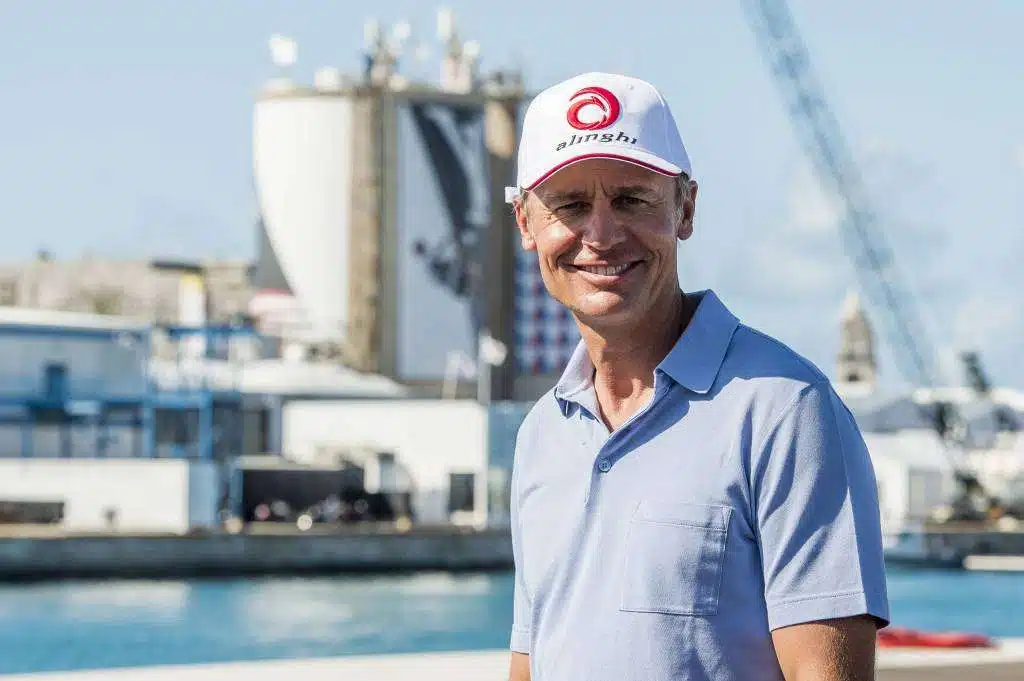
Muhammad Aljunied: Beyond business and competitive sailing, your philanthropic work through the Bertarelli Foundation—particularly focusing on marine conservation, life sciences, and education—plays a major role in your life. Why has ocean conservation become such a focal point?
Ernesto Bertarelli: If you spend as much time on the sea as I have, you develop a deep reverence for the ocean, but you also witness firsthand the fragility of marine ecosystems. We cannot just extract value from the world—whether through business or recreation—without giving back to protect it.
Our work in marine conservation, particularly around large-scale marine protected areas like those in the Indian Ocean, is about science-led preservation. We want to ensure that future generations can study, understand, and experience the ocean in its natural, pristine state. Philanthropy requires the same strategic rigor as any enterprise: you set clear goals, back serious scientific research, and commit for the long haul.
Muhammad Aljunied: Whether managing global investments, driving high-performance nautical innovation, or preserving natural habitats, what core philosophy continues to anchor your decisions?
Ernesto Bertarelli: Staying curious and refusing to stand still. Life is about motion. Whether you are solving a complex medical challenge, designing a cutting-edge racing catamaran, or exploring new frontiers in conservation, you have to maintain the drive to learn and improve. At the end of the day, your legacy isn’t just defined by what you accumulate, but by the quality of the projects you build and the people you inspire along the way.
In 2000, Ernesto innovated the yachting platoon Alinghi, which in 2003 defeated Team New Zealand in Auckland to win the America’s Cup, the first time a platoon had ever won the coveted sailing jewel on its first attempt. The palm brought the Cup back to Europe for the first time since 1851. Ernesto himself served as tar in 2003 and as an afterguard runner and grinder in 2007, when Alinghi defended the America’s Cup in Valencia, Spain.